MESSAGE TO HIS COUNTRYMEN
Enthusiasm reached its height at Madras. The city
erected for him seventeen triumphal arches, presented him with twenty-four
addresses in various languages, and suspended her whole public life at his
arrival. Here he gave an eloquent utterance to his message to India in a series
of magnificent lectures comprising ‘My Plan of Campaign”, “The Mission of
Vedanta”, and “The Future of India.” “Each nation, like each individual”, he
said, “has one theme in this life, which is its centre, the principal note with
which every other note mingles to form the harmony. If any nation attempts to
throw off its national vitality, the direction which has become its own through
the transmission of centuries, that nation dies. In India religious life forms
the centre, the keynote of the whole music of national life. Social reform has
to be preached in India by showing how much more spiritual a life the new
system will bring, and politics has to be preached by showing how much it will
improve the one thing that the nation wants. its spirituality. Therefore before
flooding India with socialistic or political ideas the land should first be
deluged with spiritual ideas. The first work that demands our attention is that
the most wonderful truths confined in our Upanishads, in our scriptures and
Puranas, must be brought out from the books, the monasteries, and the forests
and scattered broadcast over the land so that these truths many run like fire
all over the country, from north to south, and east to west, from the Himalayas
to Cape Comorin, from the Indus to the Brahmaputra.”
“Ay, let every man and woman and child without
respect of caste or birth, weakness or strength, hear and learn that behind the
strong and the weak, behind the high and the low, behind everyone, there is
that Infinite Soul, assuring the infinite possibility and the infinite capacity
of all to become great and good. Let us proclaim to every soul: Arise, awake,
and stop not till the goal is reached. Arise, awake! Awake from this hypnotism
of weakness. None is really weak; the soul is infinite, omnipotent, and
omniscient. Stand up, assert yourself, proclaim the God within you, do not deny
Him.” “It is a man-making religion that we want. It is man-making education all
round that we want. It is man-making theories that we want. And here is the
test of Truth: Anything that makes you weak physically, intellectually, and
spiritually, reject as poison; there is no life in it, it cannot be true. Truth
is strengthening. Truth is purity, truth is all knowledge.” Give up weakening
mysticisms, and be strong - the greatest truths are the simplest things in the
world, simple as your own existence.”
While delivering this inspiring message to his
countrymen the Swami was not oblivious of his duty to emphasize the need of
uplifting the sunken millions from the slough of torpor and degradation. He
struck a sharp note of warning to his compatriots and gave vent to his own
ideal of patriotism in the following stirring words: “It is we who are
responsible for all our degradation. Our aristocratic ancestors went on
treading the common masses of our country underfoot, till they became helpless,
till under this torment the poor people nearly forgot that they were human
beings. They have been compelled to be merely hewers of wood and drawers of
water for centuries. Feel, therefore, my would-be reformers, my would-be
patriots! Do you feel? Do you feel that millions and millions of the
descendants of gods and of sages have become next door neighbours to brutes? Do
you feel that millions are starving today, and millions have been starving for
ages? Do you feel that ignorance has come over the land as a dark cloud? Does
it make you restless? Does it make you sleepless? Have you forgotten all about
your name, your fame, your wives, your children, your property, even your own
bodies? Have you done that? That is the first step to become a patriot - the
very first step. Instead of spending your energies in frothy talk, have you
found any way out, any practical solution, some help instead of condemnation,
some sweet words to soothe their miseries, to bring them out of this living
death? Yet, that is no all. Have you got the will to surmount mountain-high
obstructions? If the whole world stands against you, sword in hand, would you
still dare to do what you think right??If you have these three things, each one
of you will work miracles.”
“For the next fifty years, let all other vain
gods disappear from our minds. This is the only God that is awake, our own
race: everywhere His hands, everywhere His feet, everywhere His ears, He covers
everything. All other gods are sleeping. What vain gods shall we go after and
yet cannot worship the God that we see all round us - the Virat. The first of
all worship is the worship of the Virat - of those all around us. These are our
Gods - men and animals - and the first gods we have to worship are our own
countrymen.”
Bengal did not lag behind. She also vied with
other provinces in giving a fitting reception to her favourite and
distinguished son. Hardly had the Swami reached Calcutta when hundreds of
people came to pay their personal respects to him and to hear his exposition of
Vedanta. In the day-time he made his headquarters generally in the palatial
building of Gopal Lal Seal at Baranagore and at night he stayed at the Math
which was then at Alambazar. The City’s Address of Welcome took place on 28
February 1897, at the magnificent residence of Raja Sir Radhakanta Dev Bahadur
at Shobhabazar. The meeting was presided over by Raja Binoy Krishna Dev
Bahadur, who introduced the Swami as the foremost national figure in the life
of India. There were present Rajas and Maharajas, Sannyasins, a group of
distinguished Europeans, many well-known Pandits, illustrious citizens, and
hundreds of college students. The speech which the Swami gave in reply to the
address of welcome has become famous as a masterpiece of oratory and of fervent
patriotism. During the Swami’s stay in Calcutta he was constantly visiting one
devotee of Sri Ramakrishna or another. Many distinguished people, persons of
various professions and callings as well as hundreds of enthusiastic youths
used to come daily to the Seal garden. The questioners were invariably charmed
with his knowledge and interpretation of the Shastras, and even great masters
of philosophy and university professors were amazed at his genius. But his
heart was with the educated, unmarried youths, with whom he was never tired of
speaking. He was consumed with the desire of infusing his own spirit into them
and to train some of the more energetic and religious among them, so that they
might devote their lives to the salvation of their own souls and to the good of
the world. He deplored their physical weakness, denounced early marriage,
admonished them for their lack of faith in themselves and in their national
culture and ideals. But all this was done with such unmistakable love and
kindness that they became his staunchest disciples and followers.
It goes without saying that the main interest of
the Swami’s stay in Calcutta centred round the Alambazar monastery. No words
can describe the joy of the monks when their beloved leader was with them
again. Memories of the olden days were revived, the days with the Master (Sri
Ramakrishna) and the innumerable experiences of the wandering life of everyone
were recalled, and the Swami entertained his Gurubhais (brother-disciples) and
the devotees of the Master with hundreds of tales and episodes of his life and
work in the distant West.
Of the Swami’s numerous achievements one of the
greatest was the conversion of his Gurubhais from the individualistic to the
universal idea of religious life in which public spirit and service to
fellow-men occupied a prominent place. Up to this time the ideal of the monks
of the Math was to strive for personal Mukti (liberation) and realization of
the Supreme Atman by severe penance and meditation, remaining as much as
possible aloof from the world, its cares and sorrows, in consonance with the
old conception of monastic life. But with the appearance of the Swami among
them a new order of things was inaugurated. He railed at them for their lack of
faith in themselves and in the great mission of the Master, for their failure
to organize themselves into an active body, and for their neglect in preaching
the gospel of liberation to others. The age demanded, he said, that they should
carry the new light unto others, that they themselves should show by their
example how to serve the poor, the helpless, and the diseased, seeing God in
them, and that they should inspire others to do the same. The mission of his
life, he declared, was to create a new order of Sannyasins in India who would
dedicate their lives to help and serve others. Thus the Swami interpreted his
Master .s message in a new light, showing them that their supreme duty lay in
the carrying on of the Master’s mission, the bringing about of a religious
rejuvenation by raising the condition of the masses through loving service, and
spreading the life-giving ideas of the Master over the entire world. Even while
in the West he had conveyed to his Gurubhais this message again and again
through his inspiring letters. Now, his personal presence and passionate
appeals as also his brilliant exposition of his Master’s mission completely
bore down all opposition and he electrified their imagination with the
synthetic ideal which combined in it a life of renunciation and service .a
course of strict moral discipline, contemplation, and study as also of
self-dedication at the altar of humanity for the attainment of the highest goal
of human existence.
Out of their profound faith in their leader, his
brother-disciples bowed their heads in acquiescence, knowing his voice to be
the voice of their Master; all girded up their loins to do anything and to go
anywhere, for the good of their fellow-beings at the bidding of the Swami.
Swami Ramakrishnananda, who had never left the precincts of the Math for twelve
years, went to Madras at the behest of Swami Vivekananda to open a centre there
to propagate the teachings of the Vedanta in Southern India. Swamis Saradananda
and Abhedananda had already gone to the West at the call of the Swami to help
him in the work there. And full of the same spirit, Swami Akhandananda went to
the district of Murshidabad to start famine relief work for the people dying
from starvation in the villages. The other Gurubhais of the Swami were also
ready to take up, as occasion demanded, any work of religious and philanthropic
utility launched by him, or to further his ideas and plans of work in India and
abroad. A brilliant group of young men inspired by the Swami’s life and
teachings soon joined the Order and now gallantly stood by his side to
sacrifice their lives for others, to provide the ignorant and the depressed
masses with the ways and means for the struggle for existence and make them
stand on their own feet, to preach the highest message of the scriptures to one
and all. Gradually there came into existence the various monastic centres,
Homes of Service, and the relief centres in times of plague, famine, and flood,
under the charge and with the co-operation of his Gurubhais and his disciples.
The Swami had long thought of bringing about a co-operative effort among the
monastic and the lay disciples of Sri Ramakrishna, and of organizing in a
systematic way the activities, both spiritual and philanthropic, of his
Gurubhais. In response to the Swami’s intimation of his desire to hold a
meeting for the purpose of founding an association, a representative gathering
of all the monastic and lay disciples of Sri Ramakrishna took place at the
house of a devotee.Balaram Bose.in the afternoon of 1 May 1897. With the
unanimous consent of the assembled devotees an organization was formed under
the name of the Ramakrishna Mission Association.
The duty of the Mission would be to conduct in
the right spirit the activities of the movement inaugurated by Sri Ramakrishna
for the establishment of fellowship among the followers of different religions,
knowing them all to be so many forms only of one underlying Eternal Religion. Its
methods of action would be (1) to train men so as to make them competent to
teach such knowledge or sciences as are conducive to the material and spiritual
welfare of the masses; (2) to promote and encourage arts and industries; (3) to
introduce and spread among the people in general Vedantic and other religious
ideas in the way in which they were elucidated in the life of Sri Ramakrishna.
It was further resolved that the activities of this Mission should be directed
to the establishment of Maths and Ashramas in different parts of India for the
training of Sannyasins and such of the householders as may be willing to devote
their lives to educate others. Its work in the foreign department should be to
send trained members of the Order to countries outside India to start centres
there for the preaching of Vedanta in order to bring about a close relation and
better understanding between India and foreign countries.
A practical Vedantist, Swami Vivekananda wanted
one and all to translate the Upanishadic doctrines into action in everyday
life. The Swami himself practised the ideal in his own life; he flung himself
whole-heartedly into the whirlpool of activity and thus inspired others to
follow in his footsteps and render service to the suffering humanity even under
the most trying circumstances.
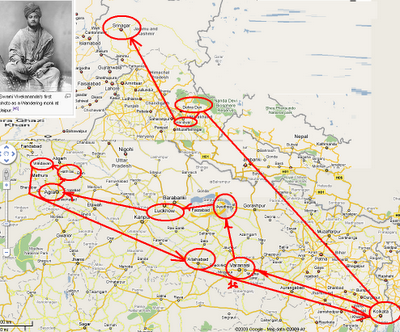
From May 1897 to January 1898, he went like a
whirlwind through the historic cities of Northern India, sowing the seed with
his characteristic boldness and zeal. Whether at Almora, Kashmir, and the
Punjab, or at Khetri, Alwar, Ajmer, and other principal states of Rajputana .
in every place the Swami was the recipient of spontaneous homage of his
countrymen from the highest to the lowest. He mixed and talked as freely and
intimately with the Rajas and Maharajas as with other sections of the Indian
people - always placing before them the vital needs of their motherland.
He was never tired of showing to his countrymen
the value and significance of the culture they had inherited from their
ancestors - a culture in comparison with which any other civilization, past or
present, paled into insignificance - till their hearts throbbed at the very
name of India. He clearly pointed out that Indian nationalism was to be based
on the greatness of the past though various new ideas also had to be
assimilated in the process of growth. If we have to be true to the genius of
the race, if we have to appeal to the soul of the nation, we have to drink deep
of the fountain of the past and then proceed to build the future. This heritage
from the past, he pointed out, was essentially a religious heritage. The
fundamental problem in India, therefore, was to organize the whole country
round the spiritual ideal. By religion he meant the eternal life-giving
principles as taught by the Shrutis and not the mass of superstitions and local
customs, which are mere accretions requiring a weeding out with a strong hand.
Above all, he showed that the nation depended upon the character and qualities
of its individual members. On the strength of the individuals lay the strength
of the whole nation. So each individual, he urged, if he desired the good of
the country as a whole, should try, whatever might be his walk of life, to
build character and acquire such virtues as courage, strength, and self-respect,
and practice the national ideals of renunciation and service.
IN THE COMPANY OF WESTERN AND EASTERN DISCIPLES
Having finished his lecture tour Swami Vivekananda
returned to Calcutta about the middle of January 1898. The Math was transferred
in February from Alambazar to Nilambar Mukherjee.s garden-house on the western
bank of the Ganga in the village of Belur. For some time the Swami devoted
himself to certain important aspects of his Mission - notably the training of
his own disciples, both Eastern and Western, so as to enable them to carry into
practice his plans for the regeneration of his motherland. His Western
disciples had come to India at his call: Miss Margaret Noble at the end of
January, to found in conjunction with Miss Henrietta F. Müller model
institutions for the education of Indian women; Mrs. Ole Bull and Miss
Josephine MacLeod in February. In March, Margaret Noble took the vow of
Brahmacharya and the name of Nivedita, the Consecrated One. Vivekananda
introduced her in warm terms to the Calcutta public as a gift of England to
India. The training of these Western disciples was of momentous concern to the
Swami as a spiritual teacher. Among the Western disciples he particularly chose
Nivedita in whom he had great hope and trust; and as such, his illuminating
discourses were mainly directed to her. The Swami was anxious that his Western
disciples should make an impartial study of Indian problems. They were not only
to see the glories, but also to have special and clear understanding of the
problems of the land and to bring the ideals and methods of Western scientific
culture to bear upon the task of finding a solution.
The Swami then set out on a journey through India
with a select group of his disciples. After a stay at Almora, were the Seviers
were already established, and then after a journey to Kashmir up the river
Jhelum through the Vale of Srinagar, the Swami undertook, at the end of July
1898, the great pilgrimage to the cave of Amarnath in the glacial gorge of the
Western Himalayas. Only Sister Nivedita was permitted to accompany him to that
holy place. On August 2, the day of the annual festival, they arrived at the
sacred cave where there was the famous ice-Shiva. Behind the other pilgrims,
Swami Vivekananda, trembling with emotion, entered the sanctuary in an almost
semiconscious condition. A great mystical experience came to him. So saturated
became his personality with the Presence of the Lord that for days afterwards
he could speak of nothing but Shiva. the Eternal One, the Great Monk, rapt in
meditation, aloof from all worldliness. Following the pilgrimage to Amarnath
the Swami’s devotion concentrated itself on the Mother, and he was soon blessed
with a wonderful vision of Kali the Divine Mother. While his vision was most
intense he wrote “Kali the Mother” - a poem, where he is seen at his best.
After this experience he retired alone abruptly on September 30 to the Coloured
Springs of Kshir Bhavani where he practised severe austerities. He was found
completely transfigured when he returned to his disciples after a few days. All
thought of leader, worker, or teacher was gone. He was now only the Monk - in
all nakedness of pure Sannyasa. So, he feelingly said to them, “It is all
“Mother” now! All my patriotism is gone. Everything is gone. Now it is only
“Mother, Mother”!” The party then came back to Lahore. The Swami’s health was
so much undermined that he had to be brought back to Bengal by Swami Sadananda,
who had hurried down from Almora after learning of the Swami.s poor
health.
They arrived at Belur, where the new monastery
was under construction, in the month of October. The Swami, in spite of his
failing health, resumed his old life with the monks and performed the
consecrating ceremony of the monastery on December 9. From January 2, 1899,
this place, now known as Belur Math, became the permanent headquarters of the
monks of the Ramakrishna Order. Gathering together his disciples, the Swami
began from now to impress on them the duties and responsibilities of their
monastic life. Hours were spent in religious conversation; scriptures were read
and commented upon; and strict regulations and monastic discipline were
instituted along with spiritual and intellectual work for certain hours of the
day. Addressing the disciples, the Swami would point out, “The history of the
world is the history of a few men who had faith in themselves. That faith calls
out the divinity within. You fail only when you do not strive sufficiently to
manifest infinite power. As soon as a man loses faith in himself, death comes.
Believe first in yourself, and then in God. A handful of strong men will move
the world. It is the salvation of others that you must seek; and even if you
have to go to hell in working for others, that is worth more than to gain
heaven by seeking your own salvation.”
In spite of illness, the Swami continued with the
organization of the Ramakrishna Mission with Swami Saradananda who had been called
back from America for this work. He soon built up a strong band of .the sappers
and miners in the army of religion. for the reconstruction of Indian life, as
also for the diffusion of Vedantic ideas throughout the length and breadth of
the world. Very soon, his dream of starting a monastery in a cool, secluded
region of the Himalayas, where the East and the West could meet on an equal
footing of love and unity, exchange the highest ideals of each, and practise
the Advaita philosophy, was also realized. Mr. and Mrs. Sevier with the help of
Swami Swarupananda, founded the Advaita Ashrama in March 1899, under the
guidance of Swami Vivekananda at Mayavati from where one can command a
magnificent view of the charming ranges of perpetual snow. Other service institutions
also sprang into existence under his directions in different parts of India,
and the Swami had the satisfaction of seeing his lofty ideal rooted deep in the
soil of his birth.
SECOND VISIT TO THE WEST
The Swami announced his intention of going to the
West in order to see the work he had founded as well as to give fresh impetus
to them. He was urged also by his friends and physicians to do so at once as
his health was very poor. This time he took with him Sister Nivedita and a
brother monk, Swami Turiyananda, and boarded the steamer on June 20, 1899. In
regard to taking Swami Turiyananda to America, the Swami said, “They have seen
the Kshatriya power- now I want to show them the Brahmin!” He meant that in
himself the West had seen the combative spirit and energy in the defence of the
Eternal Religion, Sanatana Dharma; and now the time had come when the people
should have before them the example of a man of meditation in his Gurubhai,
born and bred in the best traditions and rigorous discipline of Brahminhood.
After having broken his journey in London, he went to the United States and
stayed for almost a year. There he found Abhedananda actively engaged in the
Vedantic work. Turiyananda settled down at Mont Clair near New York, and he
himself went to California, where he founded the Vedanta Society at San
Francisco. Besides, he received the gift of a property of one hundred and sixty
acres of forest land in the district of Santa Clara, where an Ashrama was
established by Swami Turiyananda to train a select band of students in the
monastic life. Thus the work prospered and the ideas spread. But though the
Swami was full of merriment even while busy consolidating his work in America,
there was always in him the undertone of serious states of mind. Throughout his
Western experience this time one notices in him a deep yearning for the
Absolute. In one of his letters he definitely says, “Pray for me - that my works may stop for ever, and my whole
soul be absorbed in the Mother. The battles are lost and won. I have bundled my
things, and am waiting for the Great Deliverer. I am only the boy who used to
listen with rapt wonderment to the wonderful words of Ramakrishna under the
banyan of Dakshineswar. That is my true nature; works and activities, doing good
and so forth are all superimpositions. Now, I again hear his voice; the same
old voice thrilling my soul. Bonds are breaking, love dying, work becoming
tasteless; the glamour is off life. Now only the voice of the Master calling.
Let the dead bury the dead, follow thou Me.’
“I come, my Beloved Lord, I come” “Nirvana is before me. I feel it at
times, the same infinite ocean of peace, without a ripple, a breath.”
Towards the end of July 1900, the Swami started
for Paris, where he had been invited to the Congress of the History of
Religions. He stayed in Paris for about three months and left for Egypt via
Vienna, Constantinople, and Athens. The meditative habit, which had revealed
itself ever since his second visit to the West in intense forms, now reached a
veritable climax. In Paris, oftentimes his mind had been far aloof from his
environment; and here in Egypt it seemed as if he were turning the last pages
in the Book of Experience. He seemed world-weary.
Suddenly he felt a strong desire to return to
India. There in the far-off Himalayan Ashrama, Mr. Sevier, his great friend and
disciple, had given up his body - a martyr to his cause. The Swami had, as it
were, a presentiment of this. He became restless to return to India. So without
waiting a single day he took the first steamer and came back alone to his
motherland at the beginning of December 1900. The joy of his brother-monks knew
no bounds when they unexpectedly found their leader present in their
midst.
About his impression of this visit to the West
the Swami said that during his first journey he had been caught by the power,
the organization, and the apparent democracy of America and Europe. But now he
had discovered the spirit of lucre, of greed, of Mammon, with its enormous
combinations and ferocious struggle for supremacy. Material brilliance no
longer deceived him. He saw the hidden tragedy, the weariness under the forced
expenditure of energy - the deep sorrow under the frivolous mask. “Social life
in the West,” he said to Nivedita, “is like a peal of laughter: but underneath
it is a wail. It ends in a sob. The fun and frivolity are all on the surface;
really it is full of tragic intensity. Here (in India) it is sad and gloomy on
the surface, but underneath are carelessness and merriment.”
PARTING GLIMPSES
Before taking up the work that awaited him on his
return to India, the Swami’s first object was to visit Mrs. Sevier at the
Advaita Ashrama, in Mayavati. On his arrival at the Belur Math, he had the
confirmation of his premonition of the passing away of his beloved disciple,
Mr. Sevier, which had occurred on October 28, 1900. Without stopping to rest at
Belur, he telegraphed to Mayavati that he was coming to the Ashrama. He arrived
on January 3, 1901, and despite the mingled joy and emotion he felt at meeting
Mrs. Sevier again, in seeing the work finished, and in contemplating the beauty
of the Ashrama perched on the mountain-slope he could stay there only for a
fortnight; asthma suffocated him. The Swami had to come back to the Belur Math
on January 24. Apart from a last pilgrimage that he made with his mother to the
holy places of Eastern Bengal and Assam, to Dacca and Shillong, which left him
exhausted, he left Belur only for a short stay at Varanasi at the beginning of
1902. The great journey of his life was soon to end.
After his return from the tour in East Bengal and
Assam, which was the last public tour undertaken by the Swami, his health was
much worse. The monks were greatly concerned. They now urged him to have
complete rest; they begged him to give up all thought of appearing before the
public until he should be perfectly well. But as was his wont, he gave frequent
interviews to all who flocked to the Belur Math in these days from all parts of
India to receive his blessings and instructions.
At the monastery he lived a simple life, free
from the monotony of society and its tiresome conventionalities. He was a
.Sannyasin free.. He would freely walk about barefooted or with plain slippers
on and sometimes with a staff in hand. full of mirth like a boy. Here he was
free of the necessity to dress according to the dictates of society. With a
kaupin or a piece of Gerua (ochre) cloth on, he could live in a world of his
own in monastic silence and seclusion. At times he would be found taking
interest in the garden or experimenting in cooking or finding delight in the
company of his pet animals. “Bagha” the dog, ‘Hansi” the she-goat, “Matru” the
kid, an antelope, a stork, cows, and so on. At this time who could recognize in
him the world-renowned Swami Vivekananda! At other times he would instruct or
help the members of the Math in their difficulties, always manifesting the
greatest tenderness. Almost daily until his passing, he held Vedantic classes
to teach the novices the methods of meditation, inspired the workers with a
spirit of virile confidence in themselves, paid strict attention to discipline
and cleanliness, drew up a weekly timetable and kept a watchful eye over the
regularity of all the daily activities. No negligence escaped the vigilance of
the Swami. He always maintained an atmosphere of serene peace and holiness. He
was the irresistible magnet and the inmates of the Ashrama were as so many iron
filings drawn towards him, often without understanding why, but always loving
him. Every word of this great teacher was instinct with life and vigour and
acted with telling effect on all who listened.
Once when he saw some monks and Brahmacharins
going for worship to the temple, he said to them, “Where shall you go to seek
Brahman? He is immanent in all beings. Here, here is the visible Brahman! Shame
on those who, neglecting the visible Brahman, set their minds on other things.
Here is the Brahman before you as tangible as a fruit in one’s hand!” So
forceful was his utterance that everyone felt an ineffable peace and remained
for nearly a quarter of an hour rooted to the spot. The scene was
unforgettable. Everyone in the monastery was struck with amazement at the
wonderful power of the beloved Leader who with but one word could raise the
minds of all to the heights of Supreme Insight.
About the latter part of the year 1901, a number
of Santal labourers used to work in the Math grounds. One day he served a
beautiful feast for them at which he said, “You are Narayanas; today I have
entertained Narayana Himself.” Then turning towards his disciples, he said to
them, “See how simple-hearted these poor illiterate people are. Will you be
able to relieve their miseries to some extent at least? Otherwise, of what use
is our wearing the Gerua (the ochre robe of the Sannyasin)? How can we have the
heart to put a morsel into our mouths when our countrymen have not enough
wherewith to feed or clothe themselves? Let us throw away all pride of learning
and study of the Shastras and all Sadhanas for the attainment of personal Mukti
- and going from village to village devote our lives to the service of the
poor, and by convincing the rich men about their duties to the masses, through
the force of our character and spirituality and austere living, get money and
the means wherewith to serve the poor and the distressed. Alas! Nobody in our
country thinks for the low, the poor, and the miserable! Those that are the
backbone of the nation, whose labour produces food, those whose one day’s
strike from work raises a cry of general distress in the city - where is the
man in our country who sympathizes with them, who shares in their joys and
sorrows? Unless they are elevated, the great Mother (India) will never awake!
What I see clear as daylight is that the same Brahman, the same Shakti is in
them as in me! Only there is a difference in the degree of manifestation. that
is all. In the whole history of the world have you ever seen a country rise
unless there was a uniform circulation of the national blood all over its body?
Know this for certain, that no great work can be done by that body, one limb of
which is paralysed. After so much Tapasya (asceticism) I have known that the
highest truth is this: He is present in every being! These are all the manifold
forms of Him. There is no other God to seek for! He alone is worshipping God
who serves all beings!”
The days glided by in the Math as if they were
hours. Whatever the mood in which the Swami might be, for his Gurubhais and disciples
his presence was in itself a constant source of joy and inspiration. Whether he
was impatient, whether he reprimanded, whether he was the teacher or the
meditating sage, whether he was full of mirth or grave - to his Gurubhais he
was always the beloved .Naren., and to his disciples the blessed and
incomparable Guru. The joy of the Swami was great when meditation and
austerities were in full swing in the Math. Whenever his health permitted, he
joined in the morning meditation in the chapel. His presence in the meditation
room invariably lent an added power and intensity to the meditations of those
who sat with him.
In spite of his physical ailment, the Swami was
eager till the end to receive friends and visitors and instruct his disciples.
Everything must be sacrificed, even the body itself. Sometimes hearing of the
plight of earnest seekers who were refused admission to his presence by the
monks, he would be so deeply moved with pity that he would say, “Look here! Did
not the Master preach unto the very end? And shall I not do the same? I do not
care a straw if the body goes! You cannot imagine how happy I am when I find
earnest seekers after truth to talk to. In the work of waking up the Atman in
my fellow-men I shall gladly die again and again!” But on some other occasions,
in the midst of his talks his face would assume a dreamy far-away look and then
all would leave him, knowing that he wished to be left alone with his
thoughts.
THE PASSING
The last two months which the Swami passed on earth
were full of events foreshadowing the approaching end, though at times these
events passed by unsuspected by those around him. As days passed the Swami felt
more and more the necessity of withdrawing himself from the task of directing
the affairs of the Math. “How often,” he said, “does a man ruin his disciples
by remaining always with them? When men are once trained, it is essential that
their leader leaves them, for without his absence they cannot develop
themselves!” Work and all other bonds were dropping off; more than ever did he
withdraw himself from all outer concerns. Meditation became his one great
occupation. His Gurubhais and disciples were alarmed at seeing him retire into
such an atmosphere of austerity and meditation. The prophecy of Sri Ramakrishna
that Naren would merge in Nirvikalpa Samadhi at the end of his works constantly
haunted their memory. It seemed he was looking forward to a certain day on
which to throw off the bondage of the body. It was Friday, the fourth of July
1902. On that day he went to the chapel in the morning, and after closing the
windows and bolting the doors, spent three hours in meditation. Then he broke
forth in a touching song of the Divine Mother. The monks below were charmed to
hear the sweet strains of it coming from the shrine-room.
Descending the stairs of the shrine, he paced up
and down in the courtyard of the monastery, his mind withdrawn. He was heard
muttering to himself: “If there were another Vivekananda, he would have
understood what Vivekananda has done! And yet, how many Vivekanandas shall be
born in time!” The Gurubhai who, unnoticed, heard these words was startled, for
never did the Swami speak in this manner.
At noon he took his food along with all in the
refectory - contrary to his practice during these days. After the meal he took
a Sanskrit class with his disciples for about three hours. Then in the
afternoon he took a walk with one of his Gurubhais and expressed his particular
desire to establish a Vedic College in the Math. In the evening, as the service
bell in the shrine rang, he went to his room and remained absorbed in
meditation for nearly an hour. Then he laid himself down on his bed. He had his
rosary still in his hand. About an hour later, he changed sides and took a deep
breath. Another long deep breath like the preceding one, and then all was calm
and still. The tired child slept in the lap of the Mother, whence there was no
awakening to this world of Maya.
The Swami
was thirty-nine years and a few months, thus fulfilling a prophecy which was
frequently on his lips, “I shall never live to see forty.” But with the passing
of days, as one observes how the number of his disciples, devotees, and
admirers in the two hemispheres is rapidly increasing, how he is silently
influencing thousands of lives all over the world, how his fiery message is
supplying direct and indirect inspiration to hundreds of movements in his own
motherland and throughout the world for the uplift of which he thought so much
and worked so hard - one remembers the words he spoke long before his death:
“It may be that I shall find it good to get outside my body - to cast it off
like a worn-out garment. But I shall not cease to work! I shall inspire men
everywhere, until the world shall know that it is one with God!”
(the article taken from http://rkgfiji.org)


 Maharaja Ajit Singh Bahadur (1861–1901) was a ruler of the Indian


.jpg)